
 Parag Sanghani, CFA®
Key Points:
- A structural demand shift is underway. After two decades of relatively flat U.S. electricity demand, AI, data centers and reshoring are driving meaningful growth. We believe this represents the beginning of a multi-year, and potentially a multi-decade, investment cycle rather than a temporary spike.
- The opportunity spans the whole value chain. Mid-single-digit growth on a 1,400-gigawatt base means potentially hundreds of gigawatts of new demand across generation, transmission, distribution, equipment and services, not just power producers.
- Modernization matters as much as expansion. Much of today’s grid was built for a low-growth era. As electricity consumption accelerates, companies that expand capacity while improving the efficiency and reliability of existing systems can create significant value.
Power is being consumed at record rates, and for the first time in decades, electricity demand in the United States is growing in a meaningful way. This represents a significant change for an industry built around expectations of slow or even flat demand growth.
For most of the last 20 years, efficiency gains, offshoring of manufacturing and a broader shift toward less energy-intensive economic activity muted the need for new power infrastructure. Electricity consumption remained relatively flat from the mid-2000s through the early 2020s1. As a result, construction firms, utilities, power producers and service providers all operated in an environment where demand growth was limited and
largely incremental.
Today, the environment has changed drastically. The U.S. Energy Information Administration (the EIA) is now projecting real growth. The rise of artificial intelligence, the buildout of data centers and the reshoring of manufacturing are creating unheard-of levels of demand for U.S. electricity. Recent growth has been driven largely by the Commercial sector, which includes data centers, and the Industrial sector, which includes manufacturing. We believe this is not simply a one-year phenomenon, but the beginning of a multi-year — and potentially multi-decade — investment cycle.
The potential beneficiaries of this new era extend across virtually every stage of the power infrastructure value chain, from fuel production and generation to the equipment and services required to deliver electricity to end users. The U.S. power system already has an enormous installed base. The American Public Power Association estimates the country has nearly 1.4 terawatts (1,400 gigawatts) of generation capacity2. When an installed base of that size moves from essentially no growth to mid-single-digit growth, the absolute amount of new capacity, equipment and infrastructure required is substantial. A few percentage points of growth on a very large base can translate into tens of gigawatts of new demand, and that demand must be met by a complex value chain that extends well beyond power plants alone.
That value chain begins with production and generation. Natural gas remains a critical part of the U.S. power system as data centers and industrial facilities require around-the-clock electricity. Renewable power, battery storage and other forms of generation will also continue to play important roles, but that’s only one part of the story. The energy must then be transported, converted, balanced and delivered, which requires pipelines, transmission lines, substations, transformers, turbines, switchgear, software, engineering expertise and construction capacity. Each link in the chain must expand, modernize and become more efficient to support the next phase of demand growth.
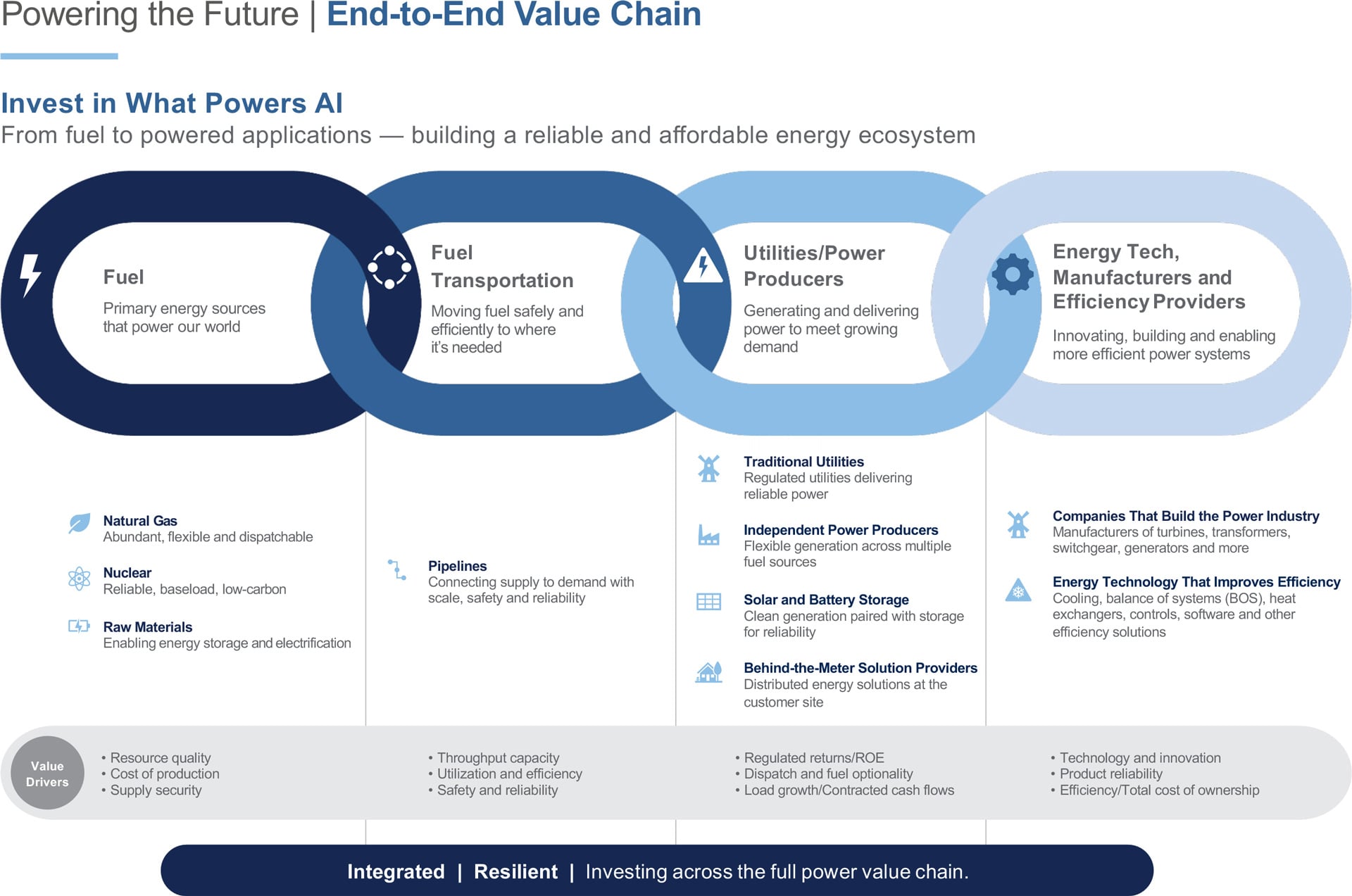
Historically, many energy-focused portfolios captured only portions of this ecosystem. They might own oil and gas producers, midstream pipelines, renewable developers or utilities. Those remain important exposures, but they do not capture the full picture of what is happening today: The power market is becoming a broader
infrastructure market.
As a result, some of the companies best positioned to participate in this cycle may not produce electricity at all. They may manufacture the equipment, construct the infrastructure, transport the fuel, improve efficiency or provide the technologies and services that enable the grid to handle higher and increasingly more complex loads.
Modernization Is as Important as Expansion
The investment cycle is not only about building more infrastructure. It is also about making the existing system work better. Much of today’s power infrastructure was designed for a different era and has operated for decades in an environment of modest demand growth.
Now, as demand accelerates, the need to replace and upgrade that infrastructure becomes more urgent. Companies that can deliver even modest efficiency improvements across a large asset base can create significant value. Better transformers, smarter grid technologies, more efficient turbines, improved storage systems and advanced services all help the power industry do more with the resources it already has.
Early in a Long Investment Cycle
For investors, we believe the timing is particularly compelling because this cycle remains in its early stages. The market has already begun to recognize the shift in electricity demand, but the full implications are still unfolding. The infrastructure required to meet growing demand will take years to plan, permit, manufacture and construct.
According to a study by the Goldman Sachs Research Commodities team, U.S. data center power demand is projected to double in less than two years3, while longer-term forecasts from BloombergNEF also point toward substantial increases in data center power requirements4. The companies that supply, build and optimize power infrastructure may therefore have the potential to benefit from a sustained investment cycle rather than a short-lived spike in demand.
This changes how investors can think about energy and power exposure. The opportunity is no longer confined to choosing among traditional energy, clean energy, industrials or utilities. Instead, the more relevant question is: Which companies are essential to supplying, building and improving the infrastructure required to meet the economy’s growing need for electricity?
That framework broadens the investable universe considerably. It includes companies involved in fuel supply, generation, pipelines, utilities, transmission, electrical equipment, engineering and construction, cooling, storage and efficiency technologies.
Power has always been essential to economic growth. What is different today is that electricity demand growth has returned after a prolonged period of stagnation at the same time that much of the existing infrastructure requires expansion and modernization.
That combination creates an unusual investment backdrop — a massive, essential market entering a new phase of growth. For long-term investors, the higher-growth areas of the energy market are no longer concentrated in a single fuel source or technology. They extend across the infrastructure ecosystem that will be required to power the next era of economic development.