
 Adrian Helfert

As we reflect on the market year to date, energy, industrial and technology stocks have experienced another period of significant change. Technological advances and geopolitical disruptions have created near-term uncertainty, but they have also reinforced the importance of identifying the physical and financial bottlenecks shaping long-term growth. The market has changed what it rewards, and we are continuing to evolve our research and investment approach accordingly. I am encouraged by the opportunities our investment teams are identifying across these changing economic and market conditions.
One Team, One Conversation
On August 31, Westwood brought our U.S. Value, Energy Infrastructure, Real Estate and Multi-Asset investment teams, along with our tactical allocation partners at Broadmark, under the leadership of a Chief Investment Officer. I expanded my role to serve as CIO, bringing these investment disciplines together under a more unified leadership structure.
This initiative is designed to strengthen collaboration through shared intelligence and research while preserving the independent thinking and decision-making of our portfolio managers. One of my priorities is improving how our teams communicate and share insights. Each Wednesday, the portfolio teams meet as one group, and each Friday, we focus on a specific topic together. For example, a pipeline analyst may see a data center’s power plan before it appears in a technology company’s quarterly report, while a real estate manager may hear what tenants are willing to pay for land with access to power and our credit team evaluates which companies can access capital and at what cost. Bringing these perspectives together gives our investment teams a more complete view.
The Backdrop: Inflation, the Fed and the Vote
We expect inflation to remain above the Fed’s 2% target for some time. The war with Iran has kept oil near $100 a barrel, core inflation remains about 3%, and heavy borrowing by both the government and AI developers continues to put pressure on longer-term interest rates. In September, the Fed raised rates for the first time since 2023. We expect the Fed to remain data dependent, and we believe that is the appropriate approach. A sharp deterioration in growth would change that outlook. If labor markets or credit conditions weaken materially, we expect the Fed to respond quickly, and we are watching those signals closely. For now, our Multi-Asset portfolio managers hold fewer long-term bonds and more short- and intermediate-term high-quality bonds, which yield approximately 5%, providing significantly positive real yields.
Americans voted on November 3, but for investors, less was on the federal ballot than the headlines may have suggested. Last year’s tax legislation had already addressed income tax rates, while tariff policy does not require congressional approval. At the state and local level, however, the implications for AI infrastructure and data-center development remain important. Data centers can place additional demands on local power, land and water while creating relatively few permanent jobs. Dozens of local measures related to data centers were on ballots across the country, reflecting growing attention to their impact on local communities. The share of voters who say data centers raise their power bills increased from 34% in February to 48% in July. With Washington taking a relatively light approach to AI regulation, some of the more immediate constraints may come from states and municipalities through permitting and restrictions on new development. We view that as another potential constraint, favoring projects that already have access to power and community support.
Where the Conversation Keeps Going
Our October energy session provided a closer look at what that means on the ground. Ted Gardner and Parag Sanghani, leaders of our Energy Infrastructure team, see more than 40 billion cubic feet per day of additional U.S. natural gas demand ahead, driven by power generation and LNG exports, compared with approximately 112 billion cubic feet per day produced today. From an energy perspective, AI is driving greater demand for natural gas and on-site power, with relatively little incremental demand for crude oil.
Our recent earnings roundtable followed the money. Debt now finances approximately one-third of AI spending, compared with less than one-tenth two years ago. The five largest cloud companies now spend 83% of their operating cash flow on capital projects, up from 41% in 2023. Scott Barnard and our Credit team are seeing greater differentiation in the bond market: spreads on the weakest high-yield bonds rose from 8.5% to 12.8% over the past year, while spreads on the strongest credits barely moved. On the Real Estate side, John Palmer’s work similarly points to the importance of access to power and committed tenants in supporting land values.
The spending keeps rising, and the limit keeps moving
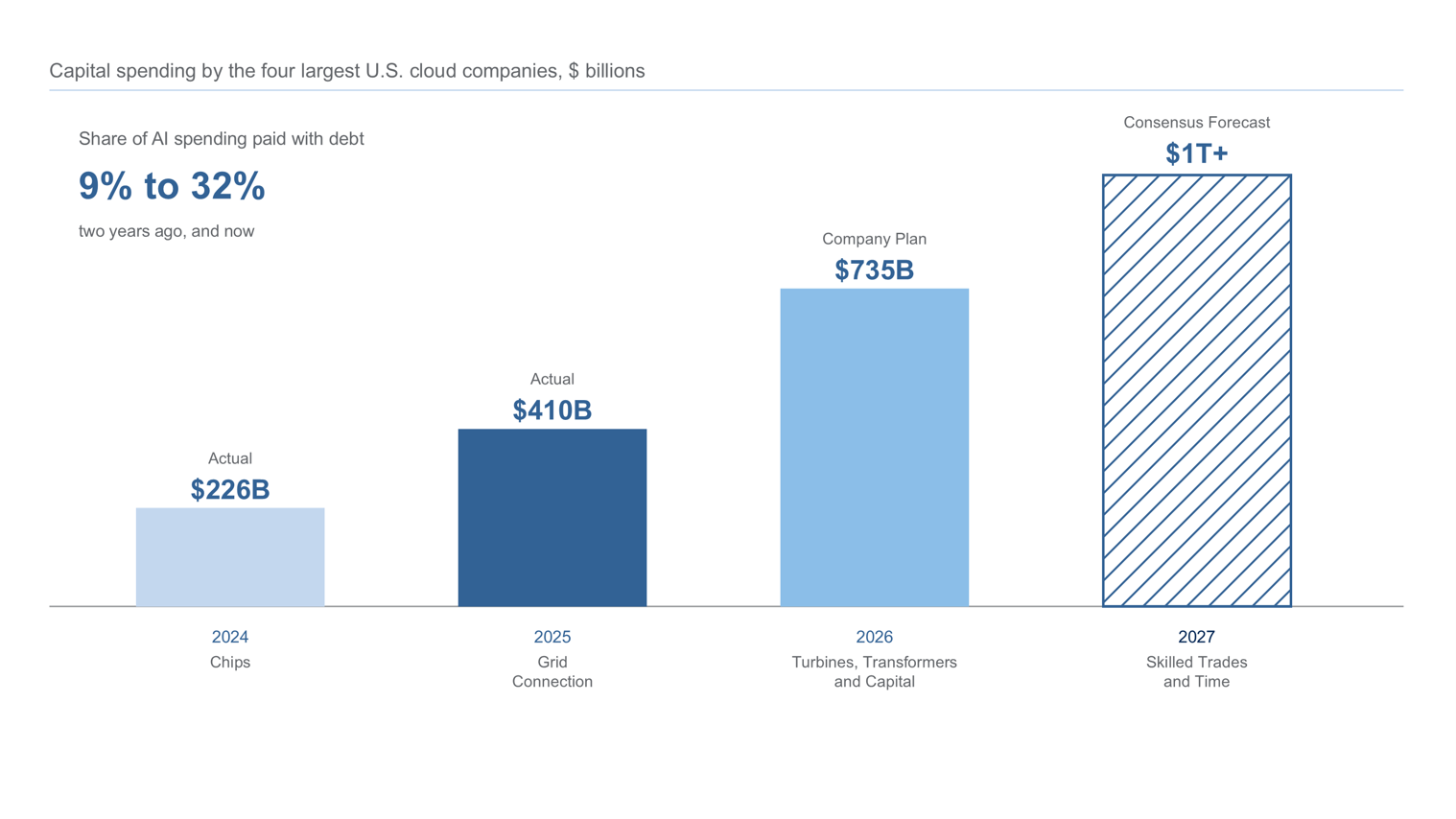
Source: company guidance (July 2026) for Microsoft, Alphabet, Amazon and Meta; Wall Street consensus for 2027; FactSet for the debt share (fiscal 2024 and latest 12 months). The input under each year is a Westwood judgment. Forecasts can change. Other data: Bloomberg, Federal Reserve, Bureau of Economic Analysis and sell-side election research, as of October 2026.
How We Invest For It
We’ve done significant research on what can constrain the continued expansion of AI infrastructure. The main finding is that the scarce resource will change over time. Two years ago, it was chips. Today, it is a grid connection, a turbine and a crew of electricians, all needed at one site and at the right time. Capital can move in quarters, while steel, permits and power can take years.
That leads us to four questions when evaluating AI-related investments: Is the power available? Who pays for it? Who bears the risk if timing disappoints? And what retains its value as this generation of chips gives way to the next?
Our approach is to focus on what is scarce, including power, grid equipment and energy infrastructure, while evaluating AI exposure across stocks, bonds and real assets rather than in isolation. We have also identified the signals that could challenge our thesis, including equipment lead times falling for two consecutive quarters, orders dropping below sales at equipment manufacturers, or project cancellations disclosed in company filings.
Looking Ahead
In September, we expanded our investment capabilities with the launch of a new strategy focused on power and infrastructure. Next spring, we’ll host an expanded forum in Dallas focused on the physical economy behind AI, and we hope to see you there.
I can’t tell you when the pace of AI infrastructure development will slow or the timing and direction of the Fed’s next policy move. What I can tell you is where we see constraints in power, infrastructure and capital, and our investment teams now bring more perspectives to evaluating those constraints than ever before. We remain focused on understanding how these dynamics are evolving and what they mean for investors.
Thank you for your continued trust and partnership.