
 Trip Rodgers, CFA®
Short-cycle industrials are manufacturers of products with lead times measured in days or weeks rather than months or years. These businesses typically produce high-volume, lower-priced, rapidly consumed components — cutting tools, fasteners, bearings, fluid-power valves, electrical connectors and basic automation sensors. Because these parts wear out quickly or are consumed directly in ongoing production, they require constant small-batch replenishment.
This structure makes short-cycle producers highly sensitive to real-time shifts in end demand. When the economy slows, distributors and end-users clear existing inventory aggressively; when demand returns, they must restock quickly. This transactional dynamic contrasts with long-cycle, secular industrials — aerospace, defense, grid infrastructure — which are driven by multi-year themes and insulated from near-term volatility by large order backlogs. The tradeoff is that short-cycle producers offer far greater visibility into the current state of the industrial economy, making them a useful leading indicator as well as an attractive investable category in their own right.
The Manufacturing Cycle Is Inflecting
The ISM Manufacturing PMI is the standard leading indicator for this segment, given its heavy weighting toward New Orders (30%) and Inventories (10%). The index has held above the 50 expansion threshold since January, following more than three years in contraction — a meaningful inflection after a prolonged post-pandemic destocking cycle.
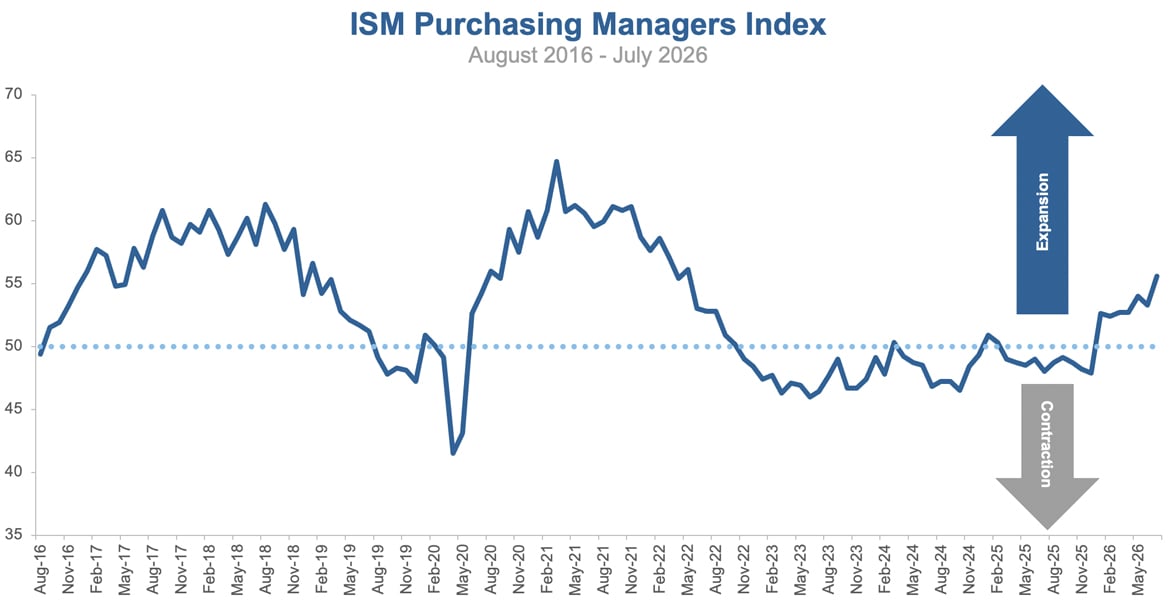
Fiscal policy has also been a contributing factor. The One Big Beautiful Bill Act, signed into law in 2025, retroactively restored 100% bonus depreciation and extended the benefit to qualified production structures, materially improving after-tax cash flow for capital-intensive businesses. Combined with broader individual tax relief supporting consumer demand, this has helped drive the recent pickup in ordering and equipment replacement. The rebound in trucking rates off depressed prior-year levels offers corroborating evidence of the restocking cycle underway.
The Investment Case
As value investors, we look for high-quality businesses that we believe are mispriced relative to their fundamentals, and we aim to establish positions before that value is broadly recognized. A number of short-cycle industrials currently meet that criteria, combining improving fundamentals with reasonable valuations.
First, short-cycle names capture the current cyclical inflection with minimal lag. Because revenue tracks order bookings within one to two quarters, these businesses will reflect the ongoing restocking cycle in near-term results, well ahead of long-cycle peers whose multi-year backlogs delay recognition.
Second, the macroeconomic backdrop is increasingly supportive. A cooling labor market and decelerating wage growth reduce the likelihood of further monetary tightening, lowering the effective discount rate applied to cyclical earnings just as those earnings appear to be troughing.
Third, and most central to our positioning, the recent industrials rally has been uneven. Long-cycle names tied to AI infrastructure and hyperscaler capital expenditures have seen multiples expand substantially, now pricing in near-flawless execution. Short-cycle peers with comparable returns on invested capital, stronger balance sheets and lower customer concentration continue to trade at a discount, largely because they lack an AI-linked narrative.
The thesis rests on this valuation dispersion within an improving operating environment: We are being compensated for comparable business quality at a discounted multiple, with the cyclical recovery serving as an additional, though secondary, support to earnings.
Where We See Opportunity
Littelfuse Inc. (LFUS) is a key enabler of the broader electrification trend, designing and manufacturing electronic components, modules and subassemblies across end markets ranging from industrial controls and data centers to consumer electronics and automobiles. Order growth has strengthened meaningfully as channel destocking has run its course, and management has noted that recent share gains are being driven by design wins rather than price, which reinforces our long-term thesis on the company’s competitive positioning. The stock trades at an attractive valuation relative to peers and, in our view, is positioned for several consecutive quarters of earnings growth.
Landstar System Inc. (LSTR) is a more recent addition to the portfolio, established opportunistically in the third quarter of 2026 following a 25% pullback in the shares. Landstar provides trucking and freight brokerage across the United States, Canada and Mexico, along with insurance and risk management services for independent contractors and third-party logistics support. A recent Supreme Court ruling favorable to truckers has, in our view, strengthened the incentive for brokers to work with carriers that maintain documented safety records, a dynamic that should benefit high-quality operators such as Landstar.
Regal Rexnord Corp. (RRX) is a global industrial manufacturer with exposure to automation, motors, motion control and power transmission products. The company has built scale through acquisitions and carries meaningful exposure to data center infrastructure as well as longer-term growth markets such as robotics and eVTOL aircraft. We believe these end markets remain underappreciated by the broader market and represent a source of long-term upside not yet reflected in the shares.
The Timken Company (TKR) manufactures bearings and industrial motion products serving the energy, agriculture, food and beverage, automotive, aerospace and rail industries, among others. Having worked through a significant period of channel destocking, the company is now benefiting from secular tailwinds in automation and renewable energy. The stock has performed well, but we believe further upside remains as management continues to raise its growth targets.