


“Peace through Strength” has been a defining feature of United States foreign policy since the founding of our nation. In the decade following the American Revolution, without the benefit of British Naval protection, United States merchant ships were frequently captured, and her sailors enslaved, by Barbary pirates. In 1793, delivering his fifth State of the Union address, President George Washington urged Congress to increase military spending to ensure that the United States could focus inwardly on its economic development as a fledgling nation. “If we desire to avoid insult, we must be able to repel it; if we desire to secure peace, one of the most powerful instruments of our rising prosperity, it must be known that we are at all times ready for war.” Less than four months later, the United States Navy was founded.
During the Reagan administration, which saw the greatest peacetime military modernization in U.S. history, foreign policy was again guided by a Peace through Strength ethos. At the 1980 Republican National Convention, Reagan outlined his beliefs: “We know only too well that war comes not when the forces of freedom are strong, but when they are weak. It is then that tyrants are tempted.” It is no coincidence then, with the threat to the United States’ national security the greatest since the Cold War, that “Peace through Strength” has become the rallying cry of the second Trump administration.
Peace through Strength, however, requires strength. The lesson of the Russo-Ukrainian War, Israel’s various skirmishes throughout the Middle East, and the Red Sea Crisis is that the U.S. defense industrial base is not the arsenal of democracy that it once was. The defense industrial base has become sclerotic, withered by the post-Cold War peace dividend and decades of wars against an unequal enemy, unable to produce weapons systems and munitions in the quantities required for a conflict with a great power. In fact, in a recent simulation of a Chinese invasion of Taiwan, the Center for Strategic & International Studies (CSIS) found that the U.S. would run out of munitions in a matter of weeks. “In every iteration of the war game, the United States expended its inventory of Long-Range Anti-Ship Missiles within the first week of the conflict, creating a critical problem of ‘empty bins.’ It takes nearly two years to produce a Long-Range Anti-Ship Missile, creating a time lag to fix the shortfall… The war in Ukraine is a stark reminder that any protracted conflict today is likely to be an industrial war. Industrial wars require a defense industry capable of manufacturing enough munitions, weapons systems and matériel to replace depleted stockpiles.” This is an untenable situation given the current threat environment and the ascendancy of China as a near-peer adversary across both conventional and nuclear domains. To reestablish deterrence and project the strength required to maintain peace, the U.S. has begun a generational recapitalization of the defense industrial base alongside a more focused pivot to the Asia-Pacific region.
Elbridge Colby, a key player in the development of the 2018 National Defense Strategy, a report that identifies the global threat environment and serves as a strategic roadmap for the Department of Defense (DOD), was nominated and confirmed to serve as the Under Secretary of Defense for Policy in 2025. The 2018 National Defense Strategy named China our pacing threat and argued for a sustained increase in defense spending, including modernizing the nuclear triad, developing space and cyberspace capabilities, enhancing C4ISR networks, investing in missile defense, and rapidly integrating AI and autonomy into existing weapons systems. Colby is currently working on the 2026 National Defense Strategy, but we need not wait until the report is provided to Congress to know which direction this administration plans to go. At the National Conservatism Conference in July 2024, Colby gave a speech that in no uncertain terms outlines the policy imperatives of the second Trump administration:
It is not hyperbole to say that we now face what Winston Churchill called a world crisis. Indeed, President Trump is right to say that we risk being on the precipice of World War III… But it’s not enough to recognize how bad things have gotten. The next conservative administration is going to have to do something about it… This is especially important because it is very clear that China is preparing for war with us over Taiwan, and the result of Beijing’s victory in such a conflict could well be its dominance of Asia or at least substantial progress in that direction. There are very sound reasons to think that China might move to precipitate such a conflict in the coming presidential term… First is the manifest military strength and resolve to use it, showing Beijing that it will not succeed in using its increasingly formidable military force to dominate Asia. This is not about soft power or photo-ops with allied leaders. This is about refocusing and husbanding our scarce military and industrial power to show Beijing that it will not gain from attacking — that the United States and, critically, our allies and partners in the region, whose fates are even more threatened by China’s ambitions, can and will be able to deny its aggressive moves against us.
Given the U.S.’s shrinking share of global GDP and fiscal constraints, a forceful pivot to countering China’s ascendancy requires placing more of the global defense burden on our allies. The U.S. can no longer afford to act alone in defense of Western ideals. To the dismay of many in the Pentagon in Congress, this policy of “Conservative Realism” is already taking shape. President Trump did not hesitate to defend Israel in its skirmish with Iran, directing the Air Force to bomb Iranian nuclear facilities. The action was measured and limited, with the overarching policy goal of ensuring that Israel would become the regional hegemon, limiting the need for deeper U.S. involvement in the Middle East in the future.
Similarly, the administration has made clear to NATO allies that while the U.S. would honor its Article 5 commitments, they should no longer rely on U.S. military might alone for their national security. The message was received loud and clear, and as a result, at this summer’s NATO Summit in The Hague, Netherlands, NATO allies announced a commitment to increase their defense spending to 5.0% of GDP, an increase from just 2.1% currently. Rapid procurement of high-end weapons systems is required to replace the U.S. backstop and counter Russian aggression on the continent, which European NATO allies believe will not stop at Ukraine. Given the dilapidated state of the European Defense Industrial Base, much of that spending will be allocated to U.S. defense contractors. For context, every 50 bps increase in non-U.S. NATO spending equates to $115 billion in incremental spending This incremental demand provides additional impetus for the U.S. defense industrial base to invest in much needed production capacity, supporting both global and U.S. demand for weapons.
Military Spending Reaches All-Time High, but Lower as a Percentage of GDP
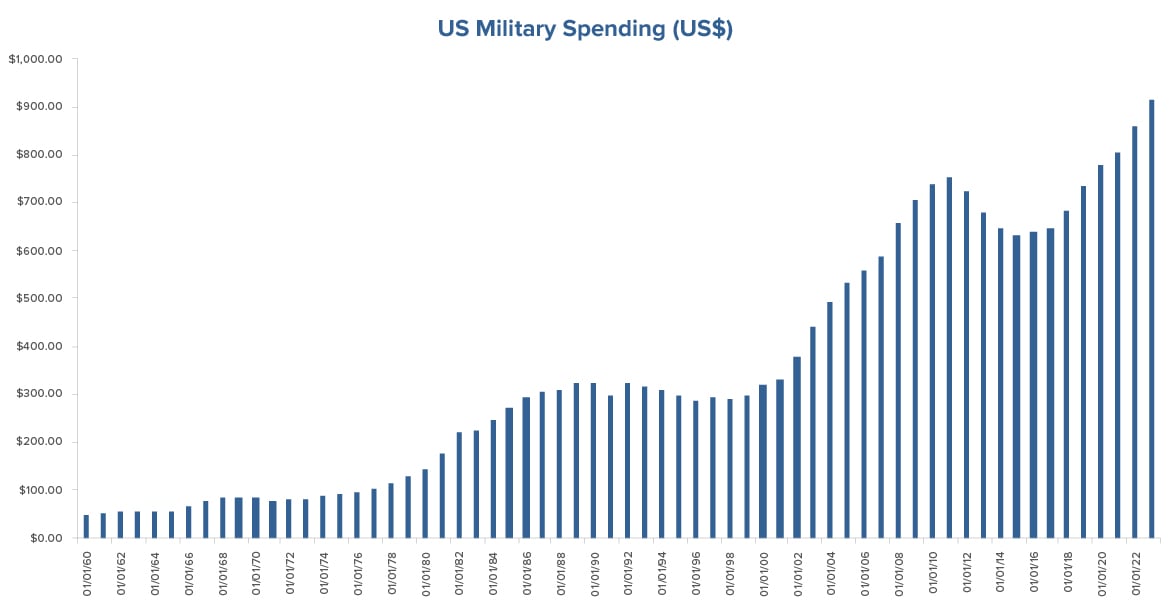
With allies in the Middle East and Europe providing for their own national security, the U.S. can then focus its limited resources on investment in the unique capabilities required to counter China in the Pacific, including submarines, stealth fighter jets, long-range bombers, missiles and missile defense. Conservative Realism, which takes a limited view of U.S. capabilities, may be controversial, but the need to increase defense spending is not. There is — thankfully — bipartisan support in Congress to reverse decades of underinvestment in U.S. defense.
While the Defense budget has been on an uptrend since 2015, in inflation-adjusted terms, the 2025 budget is well below 2009 levels. As a percentage of GDP and as a percentage of the government’s budget, defense spending is at all-time lows, despite the threat environment being the worst it’s been since the Cold War. What’s more, the Procurement and Research, Development, Test, and Evaluation (RDT&E) accounts within the DOD’s budget, which represent procurement and investment in weapons systems, is 30% below that of the Reagan-era defense buildup on an inflation-adjusted basis.
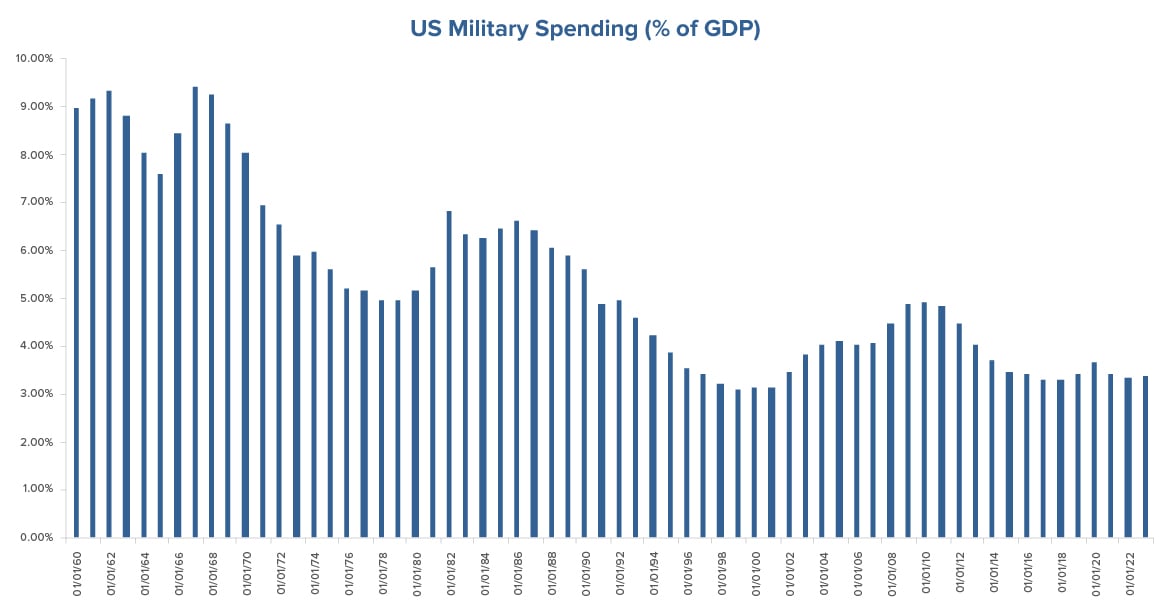
To remedy this, Congress provided $150 billion in mandatory Defense spending within the One Big Beautiful Act, 84% of which is allocated to the Procurement and RDT&E accounts. Of that, $113 billion is expected to be allocated within Fiscal 2026, representing a 22% year-over-year increase in weapons spending, returning the share of the DOD budget allocated to weapons spending to the 45% level last seen during the Reagan administration. Furthermore, Secretary of Defense Pete Hegseth has directed the Pentagon to reallocate 8% of the defense budget in each of the next five years away from nonlethal programs toward the procurement of weapons systems.
Understanding the need to act quickly, Congress has also passed — on a bipartisan basis — reforms intended to streamline the DOD acquisition process, getting weapons into the hands of our warfighters quicker and at a more reasonable cost. These reforms also encourage the allocation of programs to non-traditional defense contractors, which have historically been more nimble, innovative and cost-effective.
The defense industrial base did not atrophy over the course of a single presidential administration and will not be rebuilt in a single administration, either. That said, the down payment on the rebuild has been made, and the industry has been told to expect sustained budget growth for the foreseeable future. With a supportive Congress and unrivaled U.S. economic dynamism, the defense industrial base will meet the moment and restore Peace through Strength.
Westwood Positioning
Our holdings are well positioned for the priorities of the new administration, with quality companies across the market cap spectrum. As of 6.30.2025, some owned names include:
- General Dynamics (GD): submarines, European land systems
A defense prime, General Dynamics offers both a robust defense business as well as commercial aircraft. The company’s Gulfstream business jet brand has seen increased demand since the depths of the COVID-19 pandemic, with visible backlogs providing for a long revenue cycle. Meanwhile the company’s defense portfolio aligns well with the current demands of the Department of Defense (DOD), including munitions, submarines, tanks and cyberwarfare capabilities. - Kratos Defense & Security Solutions (KTOS): drones, space, solid rocket motors
The company may have the largest pipeline of transformational opportunities in the defense industry. The company focuses on drones, software-defined space, electronic warfare, and propulsion, each of which is a top priority for the Department of Defense. The U.S. is repositioning its strategy to focus on low-cost, attritable systems and space-based ISR (intelligence, surveillance and reconnaissance) systems; Kratos is a leader in target drones as well as tactical drones. The company also builds satellite communication systems used in electronic warfare. - BWX Technologies (BWXT): nuclear power for aircraft carriers
The company is the sole source provider of nuclear components and nuclear fuel to the U.S. Navy, providing a highly predictable and stable source of earnings. The company is expanding that expertise to smaller modular reactors, space-based nuclear energy and oncology. This growth comes as an addition to the AI-driven power demands of data centers. - L3Harris Technologies Inc. (LHX): software-defined radios, space, solid rocket motors
The company declares itself a defense technology and aerospace innovator, building communication products and systems for ground and airborne radio systems. With a heightened focus on cyber command capabilities and a greater need for communication across the battlefield, the company is poised to show strong growth. in addition, the company’s AeroJet RocketDyne division, which it purchased in 2023, offers a platform for future growth as the need for solid rocket propulsion and hypersonic rockets increases. - CACI International (CACI): DOD IT modernization, cyber, SIGINT, EW
With increased defense spending comes the need for cyberwarfare capabilities and IT modernization. CACI International provides the basics of IT infrastructure as well as the cutting-edge cyber capabilities needed by the DOD. As Russia and China continue to show advanced cyber warfare capabilities, the U.S. will need to invest in its infrastructure and intelligence capabilities to keep up with their competitors.